THE NUMBER
What a commercial charging port costs
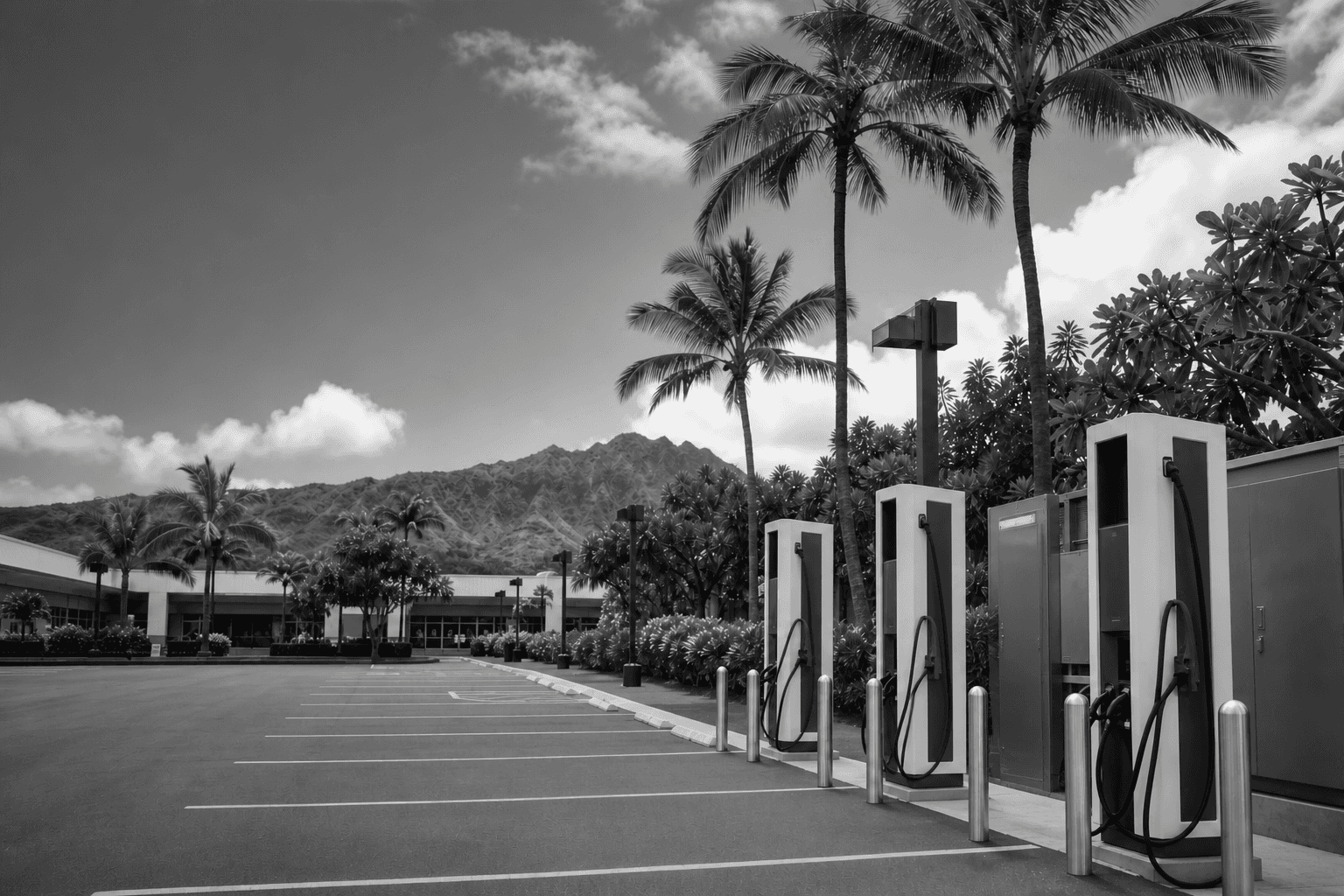
Commercial EV charging cost splits into hardware and site work. Charger hardware runs $400 to $6,500 per Level 2 port and $10,000 to $40,000 per DC fast unit. A straightforward Level 2 install covering labor, wiring, and permit fees has been reported at about $1,500 to $1,700 in the Los Angeles market, the closest reported benchmark to Riverside. Commercial-grade equipment and any electrical upgrades sit on top of that.
These are planning benchmarks, not a Riverside quote. Panel capacity, distance from the electrical room, pavement restoration, and utility service work move the real number far more than the charger brand does.
START HERE
Decide what the chargers are for before you price them
One answer sets the power level, the port count, and most of the budget: how long does a car sit in that stall? A workplace or apartment site with cars parked all day can meet its need with Level 2, because dwell time does the work for you. A retail or visitor site where cars stay ninety minutes needs more power per stall, or the charger is decoration. A fleet yard on a return-to-base schedule usually charges overnight on Level 2 and only needs fast charging when the duty cycle leaves no overnight window.
Federal guidance points workplaces and multifamily buildings toward Level 1 and Level 2, and public charging hosts toward Level 2 and DC fast. Get the tier wrong and you either overspend on service capacity you never draw or install ports nobody can use in the time they have.
THE LINE ITEMS
What belongs in the quote
A comparable quote breaks these out separately. The hardware line is the easiest to pin down early. The lines under it are where two Riverside sites with identical chargers end up thousands of dollars apart.
BUYING GUIDANCE
The site writes the budget, not the catalog
The charger is the part you shop for. The site is the part that sets the price. The biggest swing on most commercial projects is the distance between the electrical room and the stalls, because that distance becomes trenching, conduit, wire, and pavement you have to open and put back. A row of stalls along the building wall and a row at the far edge of the lot can carry the same charger and land thousands apart.
Ask two questions before anyone writes a number. How many spare amps does the panel actually have, and what is the nearest stall you would accept? If capacity is short, the project grows a panel or a service upgrade, and that is a utility conversation rather than a contractor conversation. Federal guidance puts utility engagement in the planning stage for exactly that reason.
There is also a cheaper path worth knowing. Instead of a pedestal at every space, some fleets install 120/240-volt receptacles and use portable Level 1 or Level 2 units kept in the vehicles. It lowers project cost, and a failed unit gets swapped rather than repaired in place.
TWO SITES, TWO PRICES
What makes a Riverside install cheap or expensive
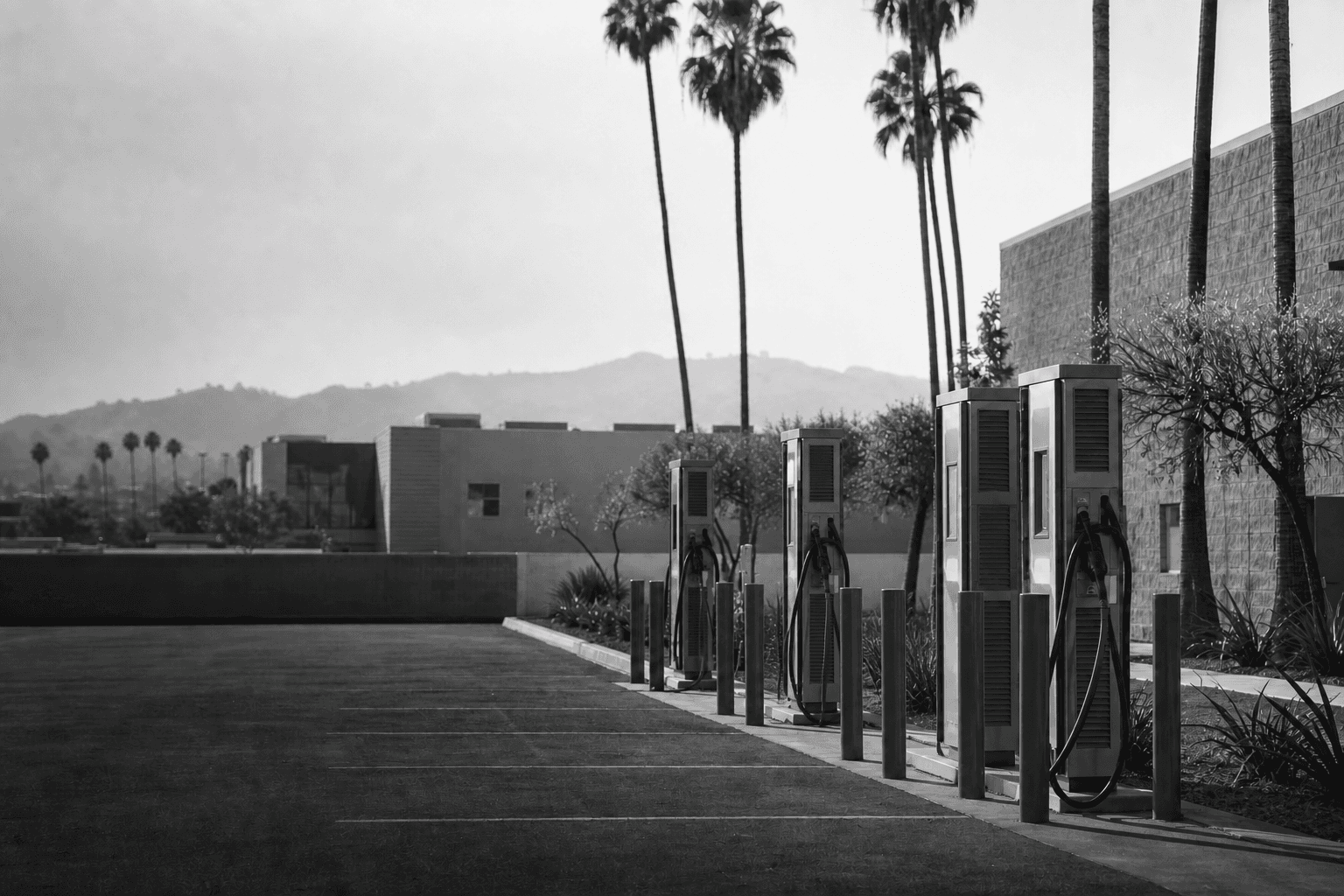
Nothing about the charger changes between these two projects. Everything about the price does.
LOWER COMPLEXITY
Short run, spare capacity
Stalls sit near the electrical room, the panel has amps to give, and the conduit path runs through landscaping or an existing sleeve. Level 2 on an existing service, minimal restoration, and a permit set that reviews cleanly.
HIGHER COMPLEXITY
Long run, full panel
Stalls sit across the lot from a panel with nothing left. Now you are cutting and repaving, adding a panel or a service upgrade, and waiting on utility work. DC fast charging lands here almost by default, since the service behind it is a different class.
BEFORE YOU BID
Scope the site so the quotes are comparable
Most of the spread between commercial charging bids is not markup. It is contractors guessing differently about the same unknowns. You remove the guessing by scoping the site first and handing every bidder the same picture.
Start with the electrical room: service size, panel schedule, and what capacity is genuinely available after existing loads. Then walk the conduit path and mark what it crosses — landscaping, sidewalk, drive aisle, structural slab. Each surface has a different restoration cost. Decide the stall count you want now and the count you want in five years, because the trench is the expensive part and you only want to dig it once.
Then settle the operating questions early, since they change the hardware: will you bill drivers, do you need utilization data, and does the equipment need a network connection at all. Federal guidance treats networking, payment, and ownership as planning decisions rather than afterthoughts, and it is right. A non-networked charger and a networked one are different purchases with different recurring costs.
Hand every bidder the same packet
Panel schedule and available capacity, a site plan with the stalls and the conduit path marked, surface types along that path, the port count now and later, and whether the chargers must bill and report. Same inputs, comparable bids.
RIVERSIDE
What this city adds to the schedule
Riverside's electric service is run by the city's own municipal utility, so service planning and building permits both sit with city departments rather than a distant investor-owned utility. That is generally good for coordination, but it does not remove the sequence: utility review of your load, permits, construction, inspection, then energizing. Any service upgrade or transformer work usually sets the critical path, not the chargers.
Inland Riverside also runs hot through the summer. Weather is a real siting factor for charging equipment, and it argues for shaded or sheltered placement where the layout allows, plus honest attention to the cable management and cleaning that keeps units in service. Heat does not change the quote, but it does change where you would rather put the pedestals.
Bring the utility in during planning
Federal guidance puts utility engagement in the planning phase for a reason. Service capacity and any upgrade work decide both the budget and the energize date, and finding out after design means redoing the design.
AFTER COMMISSIONING
Two decisions that outlive the install
The capital number gets all the attention, but two choices you make during procurement follow the site for years. Settle both in writing before construction, because renegotiating them after the chargers are in the ground is expensive and slow.
OWNERSHIP
Who owns the equipment
Equipment you own outright lowers overall cost and gives you full control, but every repair, warranty question, and replacement is yours. Provider-owned models shift that burden and the pricing. Either way, put maintenance responsibility in the contract with a response time and an uptime requirement.
OPERATING COST
What the meter does next
Electricity is charged per kilowatt-hour and often on demand, typically set by the highest 15-minute average in a billing period. DC fast charging triggers demand charges far more readily than Level 2. Ask your utility about time-of-use or charging-specific rates before you size anything.
PHASING AND FUNDING
Trench once, energize twice
Build for the ports you will need, not only the ports you need this year. Conduit and trenching are the expensive, disruptive part of a commercial charging project, and the marginal cost of oversizing conduit and pulling extra capacity during the first dig is small compared with reopening the same pavement in three years. Federal siting guidance lists future expansion alongside power proximity and weather as a first-pass siting factor. Treat it that way: install the full underground path now, populate a portion of the stalls, and leave the rest ready.
On funding, sequence matters more than optimism. Explore state, local, and utility incentives during planning and apply before construction begins, because programs generally do not pay backward. The federal 30C refueling property credit, which covered up to 30 percent of purchase and installation cost at qualifying locations, is closed to projects placed in service after June 30, 2026 — treat it as history rather than budget. Chargers remain depreciable business property, so your accountant belongs in the conversation before you finalize the capital plan.
Then carry the recurring lines into your model: electricity and demand, maintenance of up to $400 per charger per year, network fees, and warranty renewals.
QUOTE CHECKLIST
Five things a comparable quote shows
If a bid gives you one number and a charger model, you cannot compare it to anything. Ask for these five, and the differences between bidders stop being mysterious.
01
Hardware, itemized
Model, port count, connector type, mounting, activation, and whether the unit is networked.
02
The electrical run
Trench length, conduit and wire sizing, surfaces cut, and who pays for restoring the pavement.
03
Capacity findings
Existing service size, amps available after current loads, and any panel or service upgrade assumed.
04
Permits and utility scope
Permit fees, inspection coordination, utility review, and the schedule those steps imply.
05
Recurring costs
Network and software fees, warranty term and renewal price, and the maintenance response and uptime commitment.
Keep planning locally
Related EV charging pages in Riverside
Get a defensible number
Price the equipment and the building together.
Send the address, operating target, and target opening date. Flux will identify what must be verified before the project can be priced.
Price my chargersQuestions
Straight answers.
How much is the charger itself for a commercial Level 2 port?
Single-connector Level 2 hardware runs $400 to $6,500, depending on power, build quality, and whether the unit is networked. That is equipment only. Installation, permits, and any panel work are separate lines and usually the larger share on a commercial site.
Why is DC fast charging so much more expensive?
The hardware alone runs $10,000 to $40,000 per unit, and the electrical service behind it is a different class of work. Fast charging also triggers demand charges far more readily than Level 2, so the operating bill rises with the capital cost.
What makes one Riverside site cheaper to install on than another?
Spare panel capacity and stalls close to the electrical room. Distance and a full panel are the two conditions that turn a small project into a large one, because they add trenching, pavement restoration, and utility service work.
Can I still count on the federal charger tax credit?
Not for new work. The 30C refueling property credit, worth up to 30 percent of purchase and installation cost at qualifying locations, is closed to projects placed in service after June 30, 2026. Build the budget on state and utility programs, and apply before construction.
What should I budget for upkeep each year?
Plan on up to $400 per charger annually for maintenance, plus network fees if the units are connected. Annual extended warranties for DC fast chargers can exceed $800 per charger. Put response time and uptime requirements in the maintenance contract.
Sources used for this guide
- [1]afdc.energy.gov — Alternative Fuels Data Center: Procurement and Installation for Electric Vehicle Charging Infrastructure
- [2]irs.gov — IRS Alternative Fuel Vehicle Refueling Property Credit
- [3]winsparking.com — Fleet EV Charging in Denver, CO | Wins Parking
- [4]promatcher.com — EV Charging Station Cost - Los Angeles, California
- [5]afdc.energy.gov — Alternative Fuels Data Center: Operation and Maintenance for Electric Vehicle Charging Infrastructure
- [6]afdc.energy.gov — U.S. DOE AFDC Electric Vehicles for Fleets