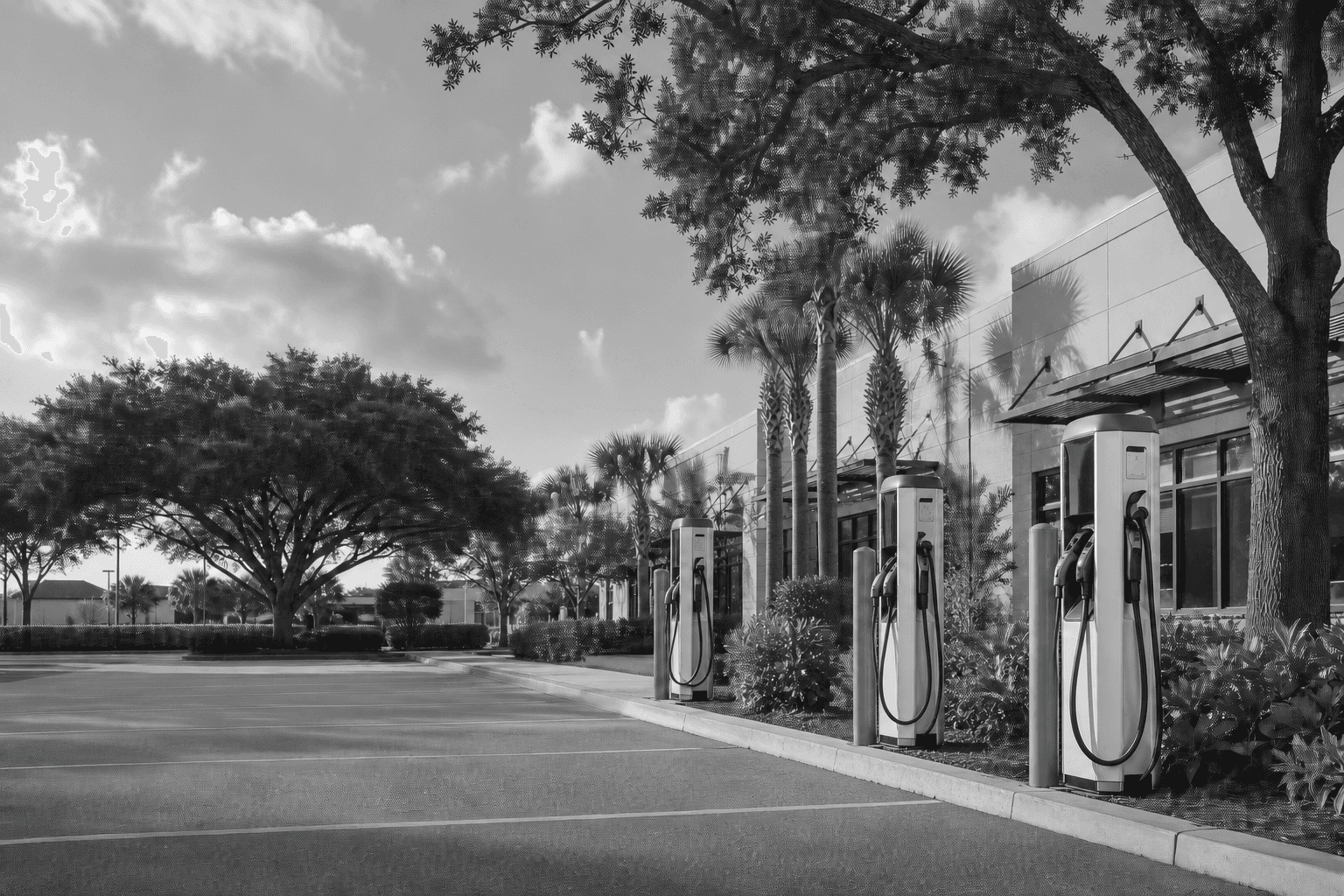
DIRECT ANSWER
Commercial EV charger installation in Houston.
A complete commercial installation covers the site and electrical assessment, charger selection, utility coordination, engineering, permits, construction, inspections, commissioning, and turnover. Level 2 charging often connects through commercial distribution equipment. DC fast charging can require much more power, larger equipment, added utility work, and a longer development plan.
The site review must verify electrical capacity, service limits, charger locations, cable routes, parking access, communications, drainage exposure, and room for expansion.
OPERATING PLAN
Make three choices before selecting chargers
Start with the vehicles, not the charger catalog. Ask who will charge, how long each vehicle normally remains parked, and how much energy it must receive before leaving. An office may value broad access across a workday. A fleet may need each assigned vehicle ready for a fixed departure. Public charging may need payment, clear wayfinding, reliable communications, and customer support.
These facts determine whether Level 2 or DC fast charging fits the job. They also shape port count, power allocation, access rules, and network features. A high-power charger is not automatically the better choice. It may add electrical and utility scope without improving operations. A lower-power design can also fail if vehicles turn quickly or need large energy transfers. Write the operating plan first so the electrical design and equipment quote solve the same problem.
QUOTE STRUCTURE
What changes the installation budget
Equipment is only one budget line. Ask bidders to separate the charger purchase from electrical, civil, utility, software, and closeout work so major assumptions remain visible.
EQUIPMENT CHOICE
Level 2 and DC fast charging create different projects
Level 2 equipment supplies AC power, while the vehicle converts that power for its battery. It often fits workplaces, tenant parking, overnight fleet parking, and other locations where vehicles remain for a useful period. The design still needs dedicated electrical capacity, safe mounting, cable management, protection, signage, and an operating plan. Several ports may share available capacity when a suitable load-management system is part of the design.
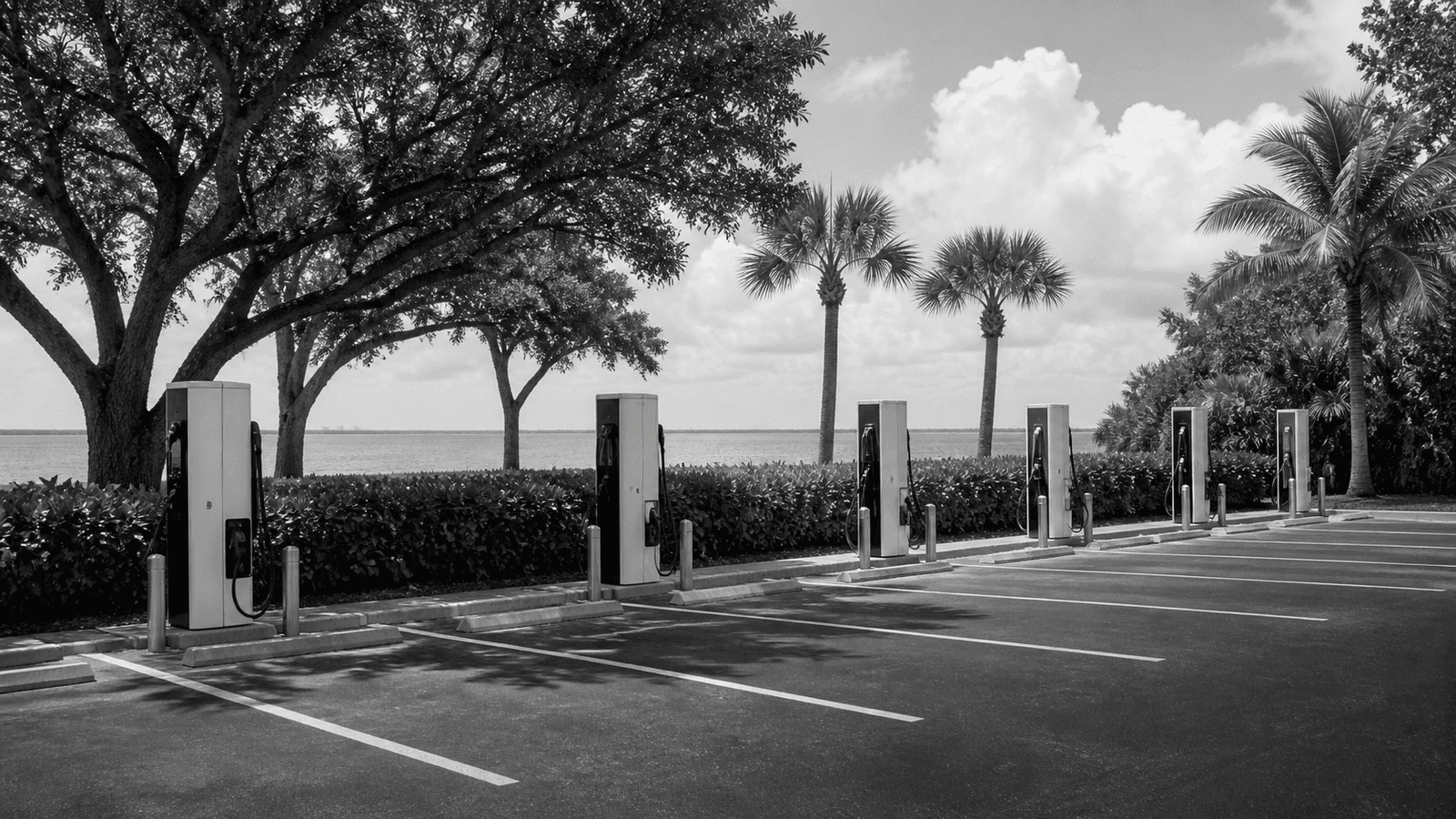
DC fast equipment converts power outside the vehicle and sends DC power to the battery. Faster charging can support short stops or fleet turnaround, but the installation may need larger conductors, switchgear, transformers, service equipment, cooling support, and closer utility involvement. Equipment size and vehicle circulation also matter. A cabinet, dispenser, protective barriers, and charging position must work together without creating unsafe backing or blocked travel paths.
Compare equipment by the service it provides, not just its maximum rating. Review connector compatibility, network dependence, warranty terms, support process, replacement parts, environmental rating, payment needs, and the power accepted by expected vehicles. The selected charger should fit both today’s use and a realistic expansion plan.
PROJECT COMPLEXITY
Know which kind of site you have
Two projects with the same number of charging ports can require very different work. Existing capacity and a short electrical route reduce complexity. Service changes and major parking construction increase it.
LOWER COMPLEXITY
Capacity is nearby
The building has verified capacity, suitable distribution equipment, a short cable route, workable parking spaces, and no major utility change.
HIGHER COMPLEXITY
Infrastructure must grow
The project needs service upgrades, utility equipment, long trenching, major restoration, new communications, or tight construction phasing around active parking.
SITE REVIEW
Turn the walk-through into a buildable scope
A useful site review follows power from the utility connection to each proposed charging space. The team should document the service, transformers, switchboards, panels, existing loads, spare capacity, protective devices, and practical connection points. Nameplate information is helpful, but it does not replace the engineering work needed to confirm what the system can support.
The parking review should test more than whether a charger fits on a wall or pedestal. Check vehicle approach, accessible routes, pedestrian movement, cable reach, impact protection, signs, lighting, drainage exposure, security, and access for maintenance. Trace underground and overhead routes before fixing the layout. A short route may lower construction needs, but the nearest space is not always the best operating location.
The review should also identify communications needs and future expansion. Networked chargers may need dependable cellular or wired service. If later phases are likely, compare installing spare conduit, distribution capacity, or make-ready work during the first construction phase. Record these decisions in drawings and a written scope so every bidder prices the same project.
Ask for a site basis document
It should record assumed charger use, proposed locations, electrical findings, utility questions, communications, civil work, permit responsibilities, exclusions, and the planned expansion point.
HOUSTON REVIEW
Plan permitting and inspections before field work
The Houston Permitting Center provides a central location for many City of Houston permits, including commercial and building permits. Building Code Enforcement applies the city’s construction codes to commercial work. City guidance also states that permitted construction must remain accessible and exposed for inspection until the building official approves it.
That requirement affects scheduling. Do not cover trenches, close electrical work, or restore inspected areas before the responsible team confirms the inspection sequence. The permit plan should identify required documents, review responsibility, inspection hold points, revision handling, and final closeout. Confirm current requirements and fees for the actual property and scope before procurement because rules, processes, and charges can change.
Protect the inspection hold points
Put inspection timing in the construction schedule and assign one party to coordinate access, corrections, approval records, and permission to conceal completed work.
OWNERSHIP MODEL
Decide who owns the daily charging experience
Commercial charging continues after the electrician leaves. Someone must manage driver access, pricing or reimbursement, station status, support calls, software accounts, energy records, and repair decisions. These duties can stay with the property or be divided among an equipment vendor, network provider, operator, and maintenance contractor.
Define that structure before signing hardware and software agreements. Confirm who holds the network account, who controls pricing and user data, what happens during a communications outage, and whether the charger can operate if a service agreement ends. Also assign responsibility for cleaning, cable inspection, collision damage, warranty claims, firmware updates, and replacement parts. Clear ownership prevents a working electrical installation from becoming a poor driver experience.
HOST CONTROL
The property manages charging
The owner keeps direct control but needs staff, procedures, software access, maintenance support, and a response path for drivers.
MANAGED SERVICE
An operator handles key duties
The agreement should define fees, uptime support, data access, payment handling, repair responsibility, term length, and exit conditions.
PHASING
Build the first phase around a credible next phase
Phasing can protect capital when future demand is uncertain, but only if the first design reserves a practical growth path. Define the full target layout, then identify what must be installed now. The first phase may include chargers plus selected make-ready elements such as distribution space, raceways, pull points, pads, or communications pathways. Future work should not require removing newly finished improvements without a clear reason.
Procurement should follow the approved electrical and operating design. Confirm equipment lead times, substitutions, network setup, utility dependencies, permit status, and required startup services before issuing purchase orders. If a proposed substitute changes power, dimensions, mounting, communications, or protective requirements, send it back through design review.
Judge lifetime value across installation and operation. Consider electricity-rate effects, software fees, payment charges, maintenance, warranty coverage, replacement parts, staff time, and the cost of unavailable ports. Incentives or tax credits may affect timing, but eligibility is location- and project-specific and can change. Verify current rules with the program authority and a qualified tax adviser before treating funding as part of the approved budget.
BID COMPARISON
Five items every comparable quote should show
Require the same scope format from each bidder. A low total is not useful when critical electrical, utility, civil, software, or closeout work is hidden in assumptions.
01
Defined equipment
List charger models, power, ports, connectors, mounts, network features, warranties, quantities, and approved alternatives.
02
Complete construction scope
Show electrical equipment, conductors, trenching, restoration, protection, signage, striping, communications, testing, and cleanup.
03
Utility and permit responsibilities
Assign applications, engineering documents, fees, revisions, utility coordination, inspections, and approval records to named parties.
04
Schedule and dependencies
State equipment lead times, utility milestones, shutdowns, parking closures, inspection hold points, commissioning, and turnover dates.
05
Assumptions and ongoing costs
Separate allowances, exclusions, change-order triggers, software fees, payment charges, maintenance, training, and support obligations.
Keep planning locally
Related EV charging pages in Houston
Get a defensible number
Price the equipment and the building together.
Send the address, operating target, and target opening date. Flux will identify what must be verified before the project can be priced.
Price my chargersQuestions
Straight answers.
What is included in commercial EV charger installation in Houston?
A complete scope normally includes site and electrical review, charger selection, utility coordination, engineering, permitting, construction, inspections, commissioning, network setup when needed, training, and turnover documents. The quote should state exactly who owns each task.
Should a commercial property choose Level 2 or DC fast charging?
Choose from vehicle dwell time, required energy, turnover, available electrical capacity, and operating goals. Level 2 often suits longer parking periods. DC fast charging can support shorter stops but may require a larger electrical and utility project.
When should the electric utility join the project?
Engage the utility during planning when the project may affect service capacity, metering, transformers, or utility equipment. Early coordination helps expose required studies, upgrades, costs, and schedule dependencies before equipment is ordered.
Does a Houston commercial EV charging project need permits and inspections?
The required approvals depend on the property and scope. Houston applies construction codes to commercial work, and permitted work is subject to inspection. Confirm current permit documents, fees, inspection points, and closeout requirements before construction.
Can a commercial EV charging installation be completed in phases?
Yes. First define the intended future layout and electrical demand. Then decide which chargers and make-ready elements belong in the first phase. The design should reserve practical distribution, routing, communications, and parking options for later growth.
What should happen during charger commissioning?
Commissioning should verify electrical safety, charger operation, connector performance, communications, access controls, payment functions when used, load-management behavior, labeling, and fault reporting. Turnover should include records, warranties, accounts, training, and support contacts.
Sources used for this guide
- [1]afdc.energy.gov — Alternative Fuels Data Center: Procurement and Installation for Electric Vehicle Charging Infrastructure
- [2]betterbuildingssolutioncenter.energy.gov — DOE Better Buildings Commercial EV Charging Infrastructure Guide
- [3]driveelectric.gov — Public electric vehicle charging infrastructure playbook · Joint Office of Energy and Transportation
- [4]energy.gov — DOE Federal Workplace Charging Program Guide
- [5]houstontx.gov — City of Houston eGovernment Center - Houston Business Portal