THE NUMBER
What commercial EV charging costs in Anaheim
Commercial charger hardware sets the floor: a single Level 2 connector runs about $400 to $6,500, and DC fast units run about $10,000 to $40,000 before any electrical work is priced. Labor is the second pile — Southern California pricing puts a straightforward Level 2 charger and its wiring near $1,500 to $1,700, and commercial sites with long conduit runs or panel work climb well past that.
These are planning benchmarks, not an Anaheim quote. Panel capacity, trench distance, pavement restoration, permit timing, and utility service work move the final number far more than the charger you pick.
FIRST DECISION
What the chargers are for decides what they cost
The first cost decision is not which brand to buy. It is what the chargers are for, because the use case picks the charging level and the level sets most of the budget.
Federal guidance splits it cleanly. Workplaces and multifamily buildings, where cars sit for hours, should look at Level 1 and Level 2. Public charging hosts, where drivers want to leave quickly, should look at Level 2 and DC fast. Fleets that park overnight usually land on Level 2 as well, and portable Level 1 or Level 2 units plugged into installed 120/240-volt receptacles can cut project cost further by skipping a pedestal at every stall.
Get this right first. A site that buys DC fast charging for cars that sit eight hours pays for speed nobody uses, then pays again every month in demand charges. A site that buys Level 2 for a customer who stops for twelve minutes gets a charger nobody plugs into.
THE LINE ITEMS
Where a commercial charging budget actually goes
A commercial quote is mostly not the charger. These are the lines that decide whether your project lands near the bottom of the range or several times higher, ordered roughly by how much they can move.
THE MECHANISM
Why two identical chargers cost different money
Two buildings can buy the same charger and get quotes that differ by a factor of three. The charger is not what changed. The path to it is.
Most of a commercial charging budget is the electrical run between the service equipment and the stall: conduit, wire, trenching, and putting the pavement back the way you found it. A charger mounted on the wall of the electrical room is close to the cheapest install there is. The same charger sixty feet out in the lot means saw-cutting asphalt, trenching, backfilling, and patching, and every additional foot adds copper.
Capacity is the other half. Federal guidance tells site hosts to start with existing infrastructure for a reason. If the building already has spare amps at the panel, the chargers connect to what is there. If it does not, the project grows a subpanel, new service gear, or a utility upgrade, and that work does not care whether you ordered two ports or six. It is a step change, not a slope — which is why adding one more charger sometimes costs nothing and sometimes costs more than the first four combined.
That is why the honest way to price this is a site walk with the panel schedule open, not a number pulled off a list.
TWO SITES
Which building do you have?
Before you set a budget, figure out which of these describes your property. The gap between them is not a rounding error. It is most of the price.
LOWER COMPLEXITY
Short run, spare capacity
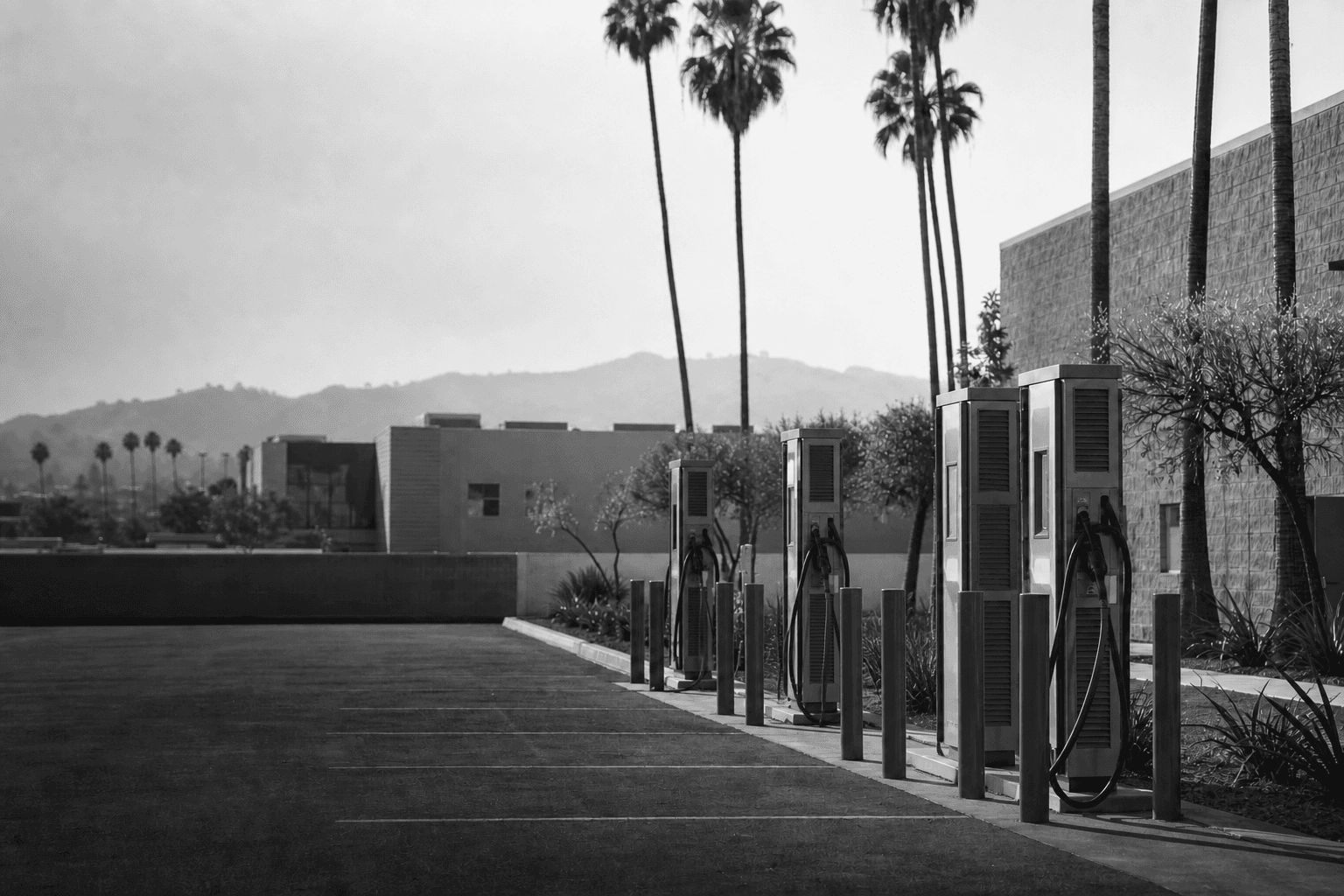
Stalls sit near the electrical room. The panel has amps to spare. The route runs through landscaping or an existing conduit path instead of fresh asphalt. Level 2 hardware, a short run, permits, inspection, done.
HIGHER COMPLEXITY
Long run, full panel, fast charging
Stalls sit across the lot behind pavement that has to be cut and restored. The panel is full, so new gear or a utility service upgrade comes first. DC fast charging pushes every one of those lines further.
SCOPING
Scope the site before you ask for a price
Ask for pricing after you have scoped the site, not before. A contractor quoting from a photo and a stall count is guessing, and guesses get revised after the trench is open.
The federal procurement checklist is a good order of operations. Start with the site itself: how close the stalls are to incoming electricity, whether metering changes are needed, and whether there is a usable network connection if the chargers have to report data. Then decide how many ports you need now and how many you expect in five years, because pulling extra conduit while the trench is already open costs a fraction of opening it twice. Where water, traffic, and sun move through the lot belongs in this conversation too.
Bring the utility in early rather than at permit time. They confirm what your existing service can carry, what upgrades the project triggers, and which rate you will be billed on — and all three change the number. Then settle the questions that trail the hardware: networked or not, who takes payment, who owns the equipment, and who is responsible when a charger goes down.
Three inputs turn a range into a quote
Walk the site with the panel schedule in hand, a port count for today and for five years out, and the utility already engaged. Those are the same three inputs that blow up budgets when they get skipped.
ANAHEIM
What this city changes about the number
Two local things move an Anaheim number. The first is the labor market. Southern California pricing for a straightforward Level 2 charger and its wiring sits around $1,500 to $1,700 in the greater Los Angeles area, and Anaheim draws from that same pool of licensed electrical labor. Commercial-grade equipment, service upgrades, and pavement restoration all stack on top of that baseline rather than replacing it.
The second is your parcel. The federal charger credit was never available everywhere — it applied only to property placed in service inside a qualifying low-income or non-urban census tract, checked by the eleven-digit tract identifier for the address. Two Anaheim buildings a mile apart can get different answers. Eligibility also turns on the date the property was placed in service, so confirm the credit's current status with your tax advisor before you subtract it from anything.
Check the tract, then check the panel
Look up your address's census tract before you build an incentive into the pro forma, and confirm with your serving utility what your existing service can carry. Both answers are address-specific, and both can swing the project by more than the chargers do.
AFTER THE INSTALL
Ownership and operating cost
The install is one number. The next ten years are another, and two decisions set most of it: who owns the equipment, and how you get billed for the power.
Owning the chargers outright costs more up front, lowers overall cost, and gives you full control — but you also carry every repair, and the warranty terms decide how much that hurts. Handing ownership to an equipment or network provider trades control for someone else's maintenance obligation. Either way, put in writing who is responsible before the first charger fails, because "the installer, probably" is not a maintenance plan.
OWNERSHIP
Own it, or let a provider own it
Fleet-owned equipment reduces overall cost and gives full control, including responsibility for every repair. Provider-owned shifts maintenance off your books and takes a share of the operation instead.
OPERATING COST
Power, demand charges, and upkeep
Per-kilowatt-hour charges are only part of the bill — demand pricing keys off the highest 15-minute average in the period, and DC fast charging triggers it far more readily than Level 2. Time-of-use rates can help.
PHASING
Open the trench once
The cheapest ports you will ever install are the ones you make ready while the trench is already open. Conduit and capacity are the expensive, disruptive parts of this work; the charger itself bolts on at the end. If you need three ports now and expect eight in five years, size the conduit and the panel for eight and energize three. The alternative is paying for pavement twice, and paying the second time at whatever labor costs then.
Procurement deserves the same look forward. Decide early whether the stations need to be networked, whether you will collect utilization data, and whether drivers will pay at the unit. Those answers change which hardware you can buy, not just which software you subscribe to. Larger organizations may also need a formal solicitation, which adds weeks before anyone quotes anything at all.
Then run the ten-year number instead of the install number. Budget up to $400 per charger per year for maintenance, and more if you go fast — annual extended warranties on DC fast chargers can run over $800 per charger. Add network fees, add electricity, and remember that off-peak and time-of-use rates change what a kilowatt-hour actually costs you. A cheap install on the wrong rate is not a cheap project.
COMPARING BIDS
Five things a comparable quote shows
Two quotes are only comparable when both spell out the same scope. Ask every bidder to break out these five in writing before you look at the totals.
01
Equipment, by unit
Make, model, connector count, power level, and whether networking hardware and activation fees are included.
02
The electrical run
Trench length, conduit and wire sizing, how much pavement gets cut, and who restores the surface.
03
Capacity work
What the panel schedule showed, any new gear or service upgrade, and the assumption used if capacity was not verified.
04
Permits and utility coordination
Which permits are filed, who files them, and where inspection sits in the schedule.
05
Coverage after handoff
Warranty term, annual network fees, maintenance response time, repair time, and the stated uptime commitment.
Keep planning locally
Related EV charging pages in Anaheim
Get a defensible number
Price the equipment and the building together.
Send the address, operating target, and target opening date. Flux will identify what must be verified before the project can be priced.
Price my chargersQuestions
Straight answers.
How much does one commercial Level 2 charging port cost in Anaheim?
The hardware alone runs roughly $400 to $6,500 per connector depending on power level and features. Installation is separate, and Southern California pricing puts a simple Level 2 charger and its wiring near $1,500 to $1,700 before commercial-grade equipment, long runs, or panel work are added.
Why is DC fast charging so much more expensive?
The equipment itself runs about $10,000 to $40,000 per unit, and the service behind it is a different class of electrical work. Fast charging also triggers demand charges far more readily than Level 2, so the monthly bill climbs alongside the install.
What makes a site cheap to install on?
Spare capacity at the panel and stalls near the electrical room. Distance and a full panel are the two conditions that turn a small project into a large one, because one adds trenching and pavement restoration and the other adds new service equipment.
Can the federal charger tax credit still cover part of my project?
It depends on both your address and your timing. The credit applies only to property in a qualifying low-income or non-urban census tract, verified by the eleven-digit tract identifier, and eligibility turns on the placed-in-service date. Confirm current status with your tax advisor before budgeting around it.
What should I budget every year after installation?
Plan on up to $400 per charger annually for maintenance, plus network fees if the stations are connected. Annual extended warranties on DC fast chargers can exceed $800 per charger, and electricity cost depends heavily on your rate and demand profile.
Sources used for this guide
- [1]afdc.energy.gov — Alternative Fuels Data Center: Procurement and Installation for Electric Vehicle Charging Infrastructure
- [2]irs.gov — IRS Alternative Fuel Vehicle Refueling Property Credit
- [3]winsparking.com — Fleet EV Charging in Denver, CO | Wins Parking
- [4]promatcher.com — EV Charging Station Cost - Los Angeles, California
- [5]afdc.energy.gov — Alternative Fuels Data Center: Operation and Maintenance for Electric Vehicle Charging Infrastructure
- [6]afdc.energy.gov — U.S. DOE AFDC Electric Vehicles for Fleets