DIRECT ANSWER
What commercial EV charger installation includes
Commercial EV charger installation in San Jose starts with a site and electrical assessment. The project then moves through charger selection, layout and engineering, utility coordination, permit plans, construction, inspection, commissioning, and staff turnover. Level 2 charging often connects to building distribution equipment. DC fast charging can require much more power, larger equipment, and earlier utility involvement.
A site review must verify available electrical capacity, parking use, accessible routes, equipment locations, utility needs, communications, and a safe construction path.
OPERATING PLAN
Make three choices before selecting chargers
Begin with the people and vehicles that will use the stations. Employees parked for a full workday need a different plan than fleet vehicles that return in short windows. Public drivers may need payment, clear pricing, dependable network access, and support. These choices shape power demand, station count, placement, software, and operating rules.
Next, decide how much control the facility needs. A simple private installation may use access controls and basic reporting. A shared or public installation may need driver accounts, payment processing, utilization records, remote troubleshooting, and pricing rules.
Finally, set the expansion plan. A first phase can install only the ports needed now while preparing electrical pathways, space, or distribution equipment for later growth. The design should show what is included today and what is merely reserved for the future.
QUOTE DRIVERS
Where installation scope can grow
Equipment is only one budget line. Compare bids by the complete installed scope and by the assumptions each contractor made.
EQUIPMENT CHOICE
Choose Level 2 or DC fast charging from the operating need
Level 2 charging is often a sound fit when vehicles remain parked long enough to receive energy over several hours. Common commercial uses include employee, tenant, overnight fleet, and longer-stay visitor charging. The design still needs a real load calculation. Several stations operating together can create a meaningful new demand on the building.
DC fast charging serves vehicles that need substantial energy during shorter stops. Its converter equipment supplies DC power directly to the vehicle. That changes the installation plan: the project may need greater electrical capacity, larger equipment areas, more heat management, different protective equipment, and closer utility coordination. Faster equipment is not automatically the better business choice. If vehicles remain parked for hours, unused charging speed may add infrastructure without improving operations.
Ask the designer to turn vehicle dwell time, daily mileage, return times, and growth into an energy plan. Charger nameplate power alone does not show whether every port must draw full power at once. Managed charging may distribute available capacity among vehicles, but its controls and operating limits must be clear.
COMPLEXITY CHECK
What makes one installation simpler than another
The charger count does not tell the whole story. Electrical distance, site work, utility capacity, accessibility, communications, and new structures can matter more than the number of plugs.
LOWER COMPLEXITY
Capacity and parking already align
A project is easier to define when usable electrical capacity is nearby, conduit routes are short, chargers fit the existing parking plan, communications are reliable, and no major utility or structural work is expected.
HIGHER COMPLEXITY
The site needs enabling work
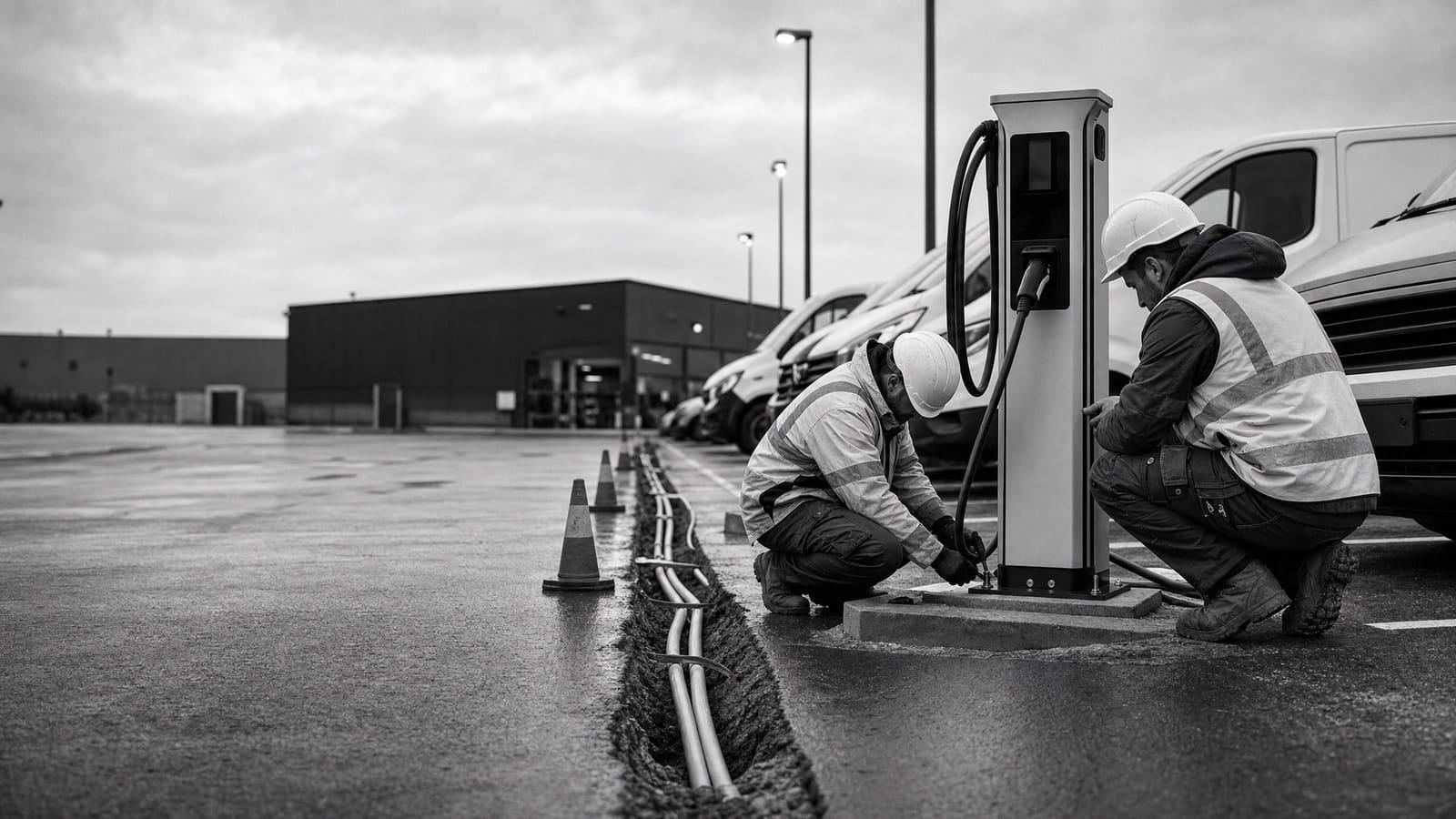
Complexity rises with service upgrades, new transformers or distribution gear, long trench routes, extensive paving work, accessible-route changes, new structures, stormwater review, or construction that disrupts active parking and traffic.
SITE REVIEW
Turn the walk-through into a buildable scope
A useful site review starts at the electrical source and ends at each proposed parking space. The reviewer should record service information, existing demand, panel and equipment condition, potential connection points, route lengths, mounting areas, and barriers between the power source and chargers. Existing drawings help, but field conditions must be checked.
The parking review should cover vehicle flow, stall use, accessible charging, pedestrian routes, impact protection, signs, lighting, drainage, and the space needed to service equipment. Networked stations also need a dependable communications plan. A weak signal discovered after construction can delay activation even when the electrical work is complete.
Operations belong in the survey too. Identify busy periods, loading activity, security rules, planned shutdowns, and areas that cannot be closed together. The resulting scope should show charger locations, electrical routing, affected surfaces, temporary controls, restoration, and assumptions that still need confirmation. That gives bidders the same basis and reduces hidden exclusions.
Bring useful records
Provide electrical one-lines, utility bills or interval data when available, parking plans, fleet schedules, planned building work, access rules, and any earlier charging studies.
SAN JOSE REQUIREMENTS
Build plan review into the schedule
San José says commercial and industrial properties installing Level 2 or higher charging stations must submit plans to obtain permits. Those plans must address the actual installation, not just the charger data sheet. The city also calls for compliance with California Building Code accessibility requirements for EV charging spaces.
Site work can add further review. New buildings or structures that are not required critical infrastructure may need a Site Development Permit, with Building Division and Fire Department review. Removing or replacing 5,000 square feet or more of impervious surface for the project requires a Planning Permit Adjustment plus review and approval of a Stormwater Control Plan. Confirm the current requirements before design is finalized.
A practical local decision
Place chargers and route power with accessibility and surface disturbance in mind. A shorter electrical path is not always the best permit or parking solution.
OWNERSHIP AND OPERATIONS
Decide who runs the charging service after turnover
Commercial charging creates an operating system, not only an electrical asset. Before procurement, assign responsibility for station ownership, electricity, network contracts, pricing, driver support, maintenance, warranty claims, and data. If tenants, employees, fleet drivers, and visitors share the same equipment, define their priorities before selecting software.
Also review the effect of charging on utility bills. Power level, simultaneous use, schedules, and the applicable rate can shape ongoing expense. Ask the project team and utility to review near-term and future charging needs. Do not base the project on an incentive until eligibility, funding, deadlines, and required approvals have been confirmed under the current program terms.
OWNER OPERATED
Keep control in the facility team
Direct ownership can preserve control over equipment and policies, but the owner must manage networking, pricing, support, maintenance, warranties, and replacement planning.
SERVICE MODEL
Define the provider’s obligations
A third-party model may shift some duties, but contracts should identify equipment ownership, uptime responsibilities, fees, data access, support response, renewal terms, and what happens if service ends.
PHASING AND PROCUREMENT
Buy the first phase without blocking the next one
A phased project can control near-term construction while protecting the long-term layout. The design may reserve electrical capacity, panel space, conduit pathways, equipment pads, or parking positions for future chargers. Each reserved item should appear on the drawings and in the price. Words such as “future ready” are too loose unless the bid states exactly what will be installed.
Procure equipment only after confirming its electrical requirements, mounting method, connector strategy, communications, accessibility implications, lead time, warranty, and network terms. The charger schedule should agree with the electrical one-line, site plan, load study, and utility request. A mismatch can create redesign or leave delivered hardware waiting for power.
Compare lifetime obligations as well as construction. Network subscriptions, payment processing, cellular service, preventive maintenance, repairs, replacement parts, software support, and warranty limits can affect the owner long after commissioning. Confirm any tax credit or incentive against current rules before treating it as project funding. Programs, eligible locations, equipment rules, and deadlines can change.
BID COMPARISON
Five things every comparable quote should show
Require bidders to price the same drawings, equipment schedule, responsibilities, and assumptions. A low total is hard to judge when major work is hidden in exclusions.
01
A defined equipment schedule
List charger models, quantities, power settings, mounts, cables, communications, accessories, warranties, and approved substitutions.
02
Complete electrical and site work
Show connection points, distribution gear, conduit, wire, trenching, protection, striping, signs, restoration, and temporary controls.
03
Utility and permit responsibilities
Name who prepares plans, submits documents, answers comments, pays fees, coordinates inspections, and handles utility applications.
04
Testing and turnover
Include energization, charger activation, network setup, functional tests, training, records, warranties, and final closeout documents.
05
Assumptions, exclusions, and schedule
State lead times, shutdowns, work hours, allowances, owner-furnished items, unknown conditions, recurring fees, and change-order rules.
Keep planning locally
Related EV charging pages in San Jose
Get a defensible number
Price the equipment and the building together.
Send the address, operating target, and target opening date. Flux will identify what must be verified before the project can be priced.
Price my chargersQuestions
Straight answers.
Do commercial EV chargers in San Jose need permits?
Yes. San José says commercial and industrial properties installing Level 2 or higher charging stations must submit plans to obtain permits. The exact review depends on the electrical, parking, structural, accessibility, and site-work scope.
Should a commercial property install Level 2 or DC fast chargers?
Choose from vehicle dwell time and daily energy need. Level 2 often suits vehicles parked for several hours. DC fast charging supports shorter stops but can require much greater capacity, larger equipment, and earlier utility coordination.
When should the electric utility join the project?
Engage the utility during planning when the load study shows a possible service or transformer constraint, and early for DC fast charging. Utility findings can change equipment, layout, schedule, and the division of work.
Can load management avoid an electrical upgrade?
It may help a design share available capacity among chargers, but it does not guarantee that an upgrade can be avoided. The engineer must compare building demand, charger settings, operating schedules, controls, and future growth.
What happens before the chargers are handed over?
The team should complete inspections, energize the system, activate network services, test charging and controls, verify payment or access functions, train responsible staff, and deliver warranties, settings, records, and maintenance information.
Are commercial EV charging incentives available in San Jose?
Availability must be checked for the specific address and project under current August 2026 rules. Do not order equipment or count funding until eligibility, deadlines, approved costs, application timing, and any preapproval requirements are confirmed.
Sources used for this guide
- [1]afdc.energy.gov — Alternative Fuels Data Center: Procurement and Installation for Electric Vehicle Charging Infrastructure
- [2]betterbuildingssolutioncenter.energy.gov — DOE Better Buildings Commercial EV Charging Infrastructure Guide
- [3]driveelectric.gov — Public electric vehicle charging infrastructure playbook · Joint Office of Energy and Transportation
- [4]energy.gov — DOE Federal Workplace Charging Program Guide
- [5]sanjoseca.gov — Electric Vehicle Charging Stations | City of San José