DIRECT ANSWER
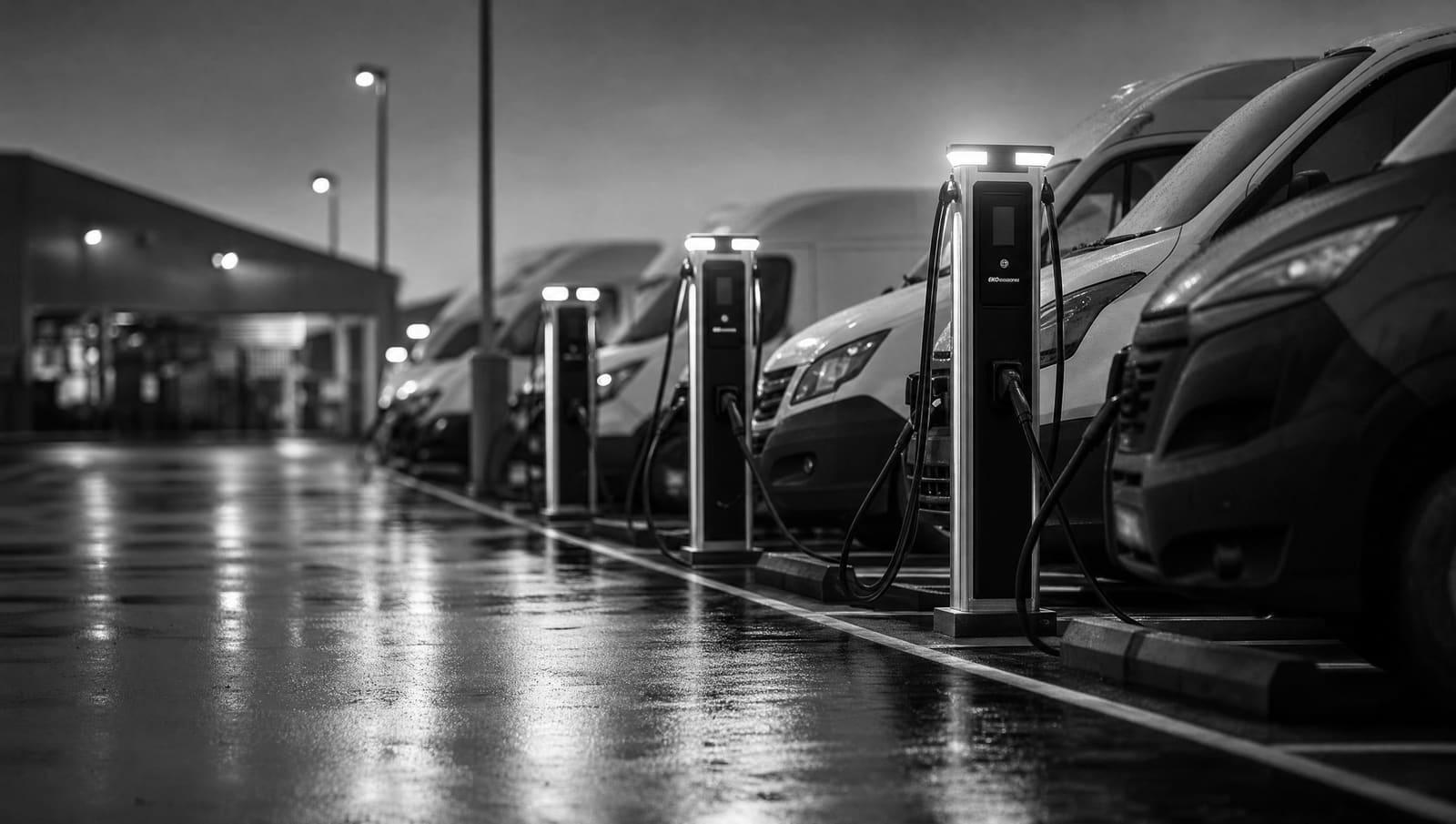
Commercial EV charger installation in Oklahoma City.
A commercial installation covers the site and electrical assessment, charger selection, utility coordination, design, permits, construction, testing, commissioning, and owner turnover. Level 2 charging often fits longer parking stays. DC fast charging serves shorter stops or rapid fleet turnover, but it can require a much larger electrical service and a more involved utility review.
The site review must verify electrical capacity, charger locations, cable routes, parking access, communications, drainage conditions, protection needs, and room for expansion.
OPERATING PLAN
Make three choices before selecting equipment
Start with the job the chargers must perform. Employee and tenant charging usually follows a long parking window. Customer charging may need simple access, clear instructions, and dependable turnover. Fleet charging must support departure times and daily routes. These patterns determine how many vehicles need energy at once and how quickly that energy must be delivered.
Next, decide who can start a session. A station can be open, limited to approved drivers, or tied to payment. That choice affects networking, software, communications, account management, and support. Finally, decide whether the first installation is the complete project or one phase of a larger plan. Future stalls can be less disruptive when conduit routes, panel space, equipment pads, and electrical capacity are considered before concrete or pavement work begins.
QUOTE DRIVERS
Where installation budgets change
The charger price is only one line. A useful budget separates the equipment, electrical work, civil work, utility scope, software, and ongoing ownership costs.
EQUIPMENT CHOICE
Level 2 and DC fast charging solve different problems
Level 2 equipment supplies AC power, while the vehicle converts that power for its battery. It is often the practical choice when vehicles remain parked for hours. That can include an employee workday, an overnight fleet window, or a longer tenant stay. The design still needs a dedicated electrical path, suitable protection, mounting details, communications where required, and a plan for sharing available power.
DC fast equipment converts power outside the vehicle and delivers DC power to the battery. It suits operations where charging time is short or vehicles must return to service quickly. The installation can place much greater demands on the building distribution system and utility service. Equipment pads, larger conductors, cooling needs, clearances, protective barriers, and utility coordination may become major parts of the job.
Do not choose by the charger label alone. Compare the energy each vehicle needs, how long it parks, how many vehicles overlap, and when they must leave. A lower-power station with enough dwell time may complete the same operating task with less infrastructure. A fast charger earns its place when the schedule truly needs it.
SITE COMPLEXITY
What makes one installation simpler than another
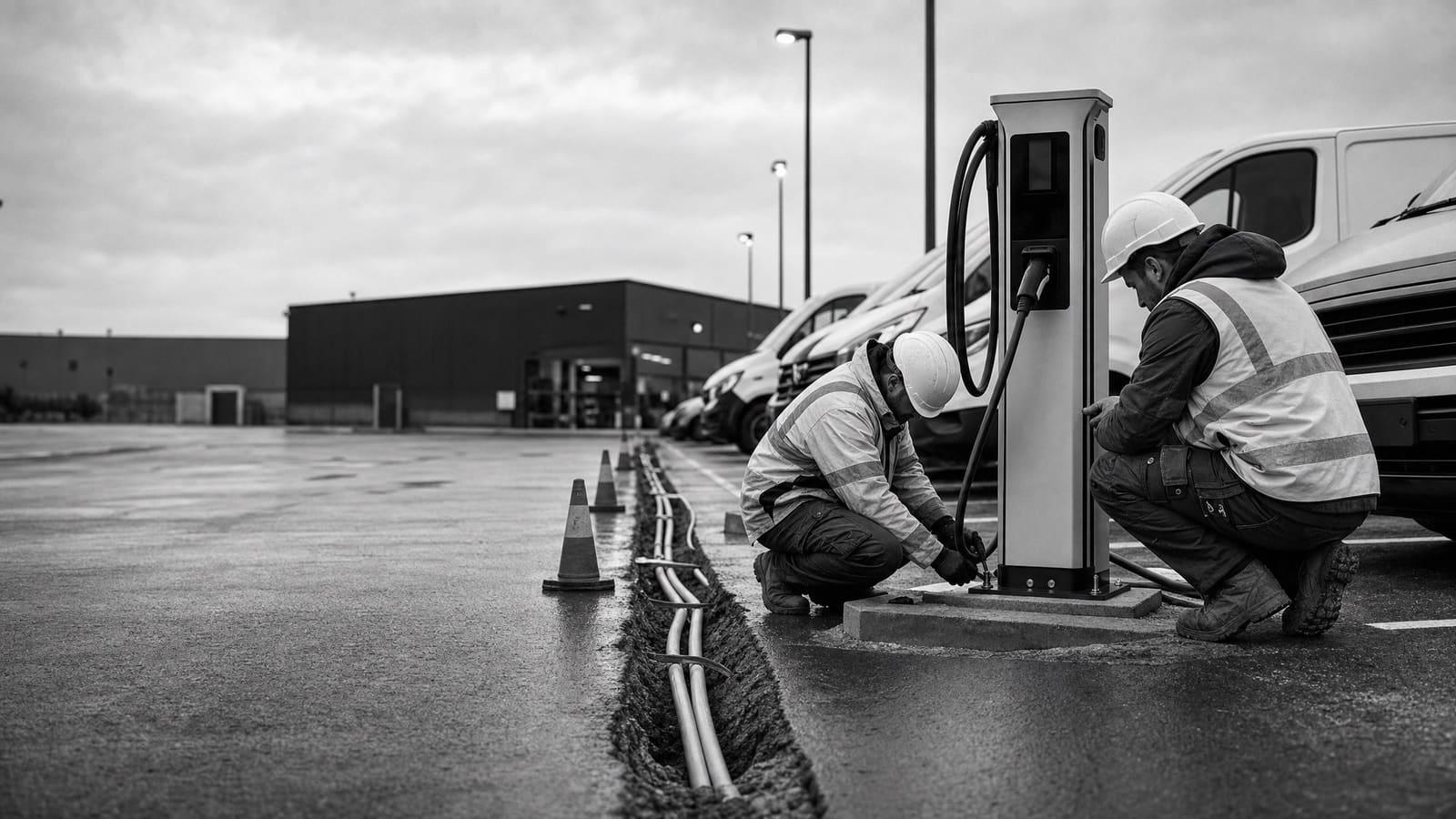
Two projects with the same charger count can have very different construction plans. Existing power, distance, surfaces, utility work, and operating constraints matter.
LOWER COMPLEXITY
Capacity and parking align
Available panel capacity, a short electrical route, accessible mounting locations, workable communications, and limited surface restoration can keep the scope focused.
HIGHER COMPLEXITY
The site needs new infrastructure
Service upgrades, long trench routes, occupied parking, phased shutdowns, difficult restoration, or DC fast charging can add design, coordination, equipment, and schedule risk.
SITE REVIEW
Turn a parking concept into a buildable scope
A commercial site review should begin at the electrical service and end at each proposed stall. The reviewer documents service characteristics, panels, transformers, available spaces, existing loads, and the route that new feeders could follow. The parking review covers stall use, vehicle approach, cable reach, pedestrian movement, signs, lighting, equipment protection, and access for maintenance.
The team should also identify surfaces that may be opened and restored. Asphalt, concrete, landscaped areas, walls, and occupied building spaces create different routing choices. Existing underground conditions should be investigated before a fixed construction price relies on them. Networked chargers also need a dependable communications plan. A strong cellular signal cannot simply be assumed at every parking location.
The result should be a marked site plan, an electrical concept, an initial load calculation, and a list of open items. Those documents let the owner compare charger options without losing sight of construction. They also show which assumptions require utility confirmation, field investigation, or final engineering before work begins.
Ask for assumptions in writing
A quote should identify assumed spare capacity, feeder distance, trench surface, utility responsibility, communications method, working hours, restoration limits, and concealed-condition exclusions.
OKLAHOMA CITY
Build permit review into the project schedule
Oklahoma City states that permits are required when work constructs, alters, repairs, enlarges, moves, or demolishes a primary or accessory structure. Commercial EV charging can involve electrical installation, equipment mounting, trenching, pavement work, or other alterations, so the permit path should be confirmed during design rather than after equipment arrives.
The City publishes requirements for commercial construction, remodeling, additions, and installations, along with separate electrical permit fee information. It also issues an inspection checklist with a required permit before work is ready for inspection scheduling. The project team should confirm which documents apply to the final scope, who submits them, and which inspections must occur before energization and turnover.
Put permit ownership in the quote
Name the party responsible for drawings, applications, fees, corrections, inspection scheduling, and final approvals. This prevents a common gap between equipment delivery and legal operation.
OWNERSHIP
Decide who operates the chargers after turnover
Commissioning is not the end of the operating plan. Someone must manage access, review station status, answer driver questions, handle payment issues, update software, and arrange repairs. The property owner may keep those duties, assign them to a network provider, or divide them among several parties.
The contract should also explain who owns each layer of the system. The physical charger, electrical infrastructure, network account, payment relationship, usage data, warranties, and service agreements may not follow the same ownership model. Clear control matters when a vendor changes, a warranty expires, or the facility expands. Before signing, confirm that the owner can access the records and credentials needed to operate the asset.
OWNER-MANAGED
More direct control
The facility keeps operating authority but must assign staff, support procedures, network administration, preventive care, and repair coordination.
SERVICE-MANAGED
More duties are outsourced
A provider may handle selected functions, but the contract must define response times, fees, data access, warranties, and exit terms.
PROCUREMENT
Buy the operating result, not only the charger
A sound request for proposals gives every bidder the same operating target. State the user group, vehicle types, parking duration, required departure time, expected charging overlap, access rules, payment policy, preferred stalls, future phase, and target opening date. Provide available electrical records and site drawings, but require field verification where accuracy affects the price.
Ask bidders to separate firm scope from allowances. Utility work, concealed underground conditions, service equipment lead times, and pavement restoration may not be fully known at the first quote. A clear allowance is easier to compare than a low total built on silent assumptions. The proposal should also state whether taxes, freight, permits, engineering, utility charges, network subscriptions, and commissioning are included.
Compare lifetime duties as well as construction. Review warranty coverage, replacement parts, software terms, payment processing, remote monitoring, service response, and who performs preventive checks. If expansion is likely, price the make-ready work now and show the cost to activate later stalls. That lets the owner decide whether installing spare conduit or electrical capacity during the first construction phase avoids a second round of disruption.
BID CHECK
Five items every comparable quote should show
Use the same checklist for each bidder. If a line is excluded or unknown, the proposal should say so plainly and explain what happens next.
01
Defined charging outcome
Charger count, power, ports, users, access rules, parking window, and future phase.
02
Complete physical scope
Electrical equipment, feeders, trenching, mounting, barriers, signs, communications, and surface restoration.
03
Utility and permit responsibilities
Design, applications, fees, corrections, inspections, service work, energization, and schedule assumptions.
04
Commissioning and turnover
Testing, network activation, payment setup, training, drawings, warranties, credentials, and operating records.
05
Exclusions and ongoing costs
Allowances, concealed conditions, subscriptions, processing fees, maintenance, support, and warranty limits.
Keep planning locally
Related EV charging pages in Oklahoma City
Get a defensible number
Price the equipment and the building together.
Send the address, operating target, and target opening date. Flux will identify what must be verified before the project can be priced.
Price my chargersQuestions
Straight answers.
What is included in commercial EV charger installation?
A complete project normally includes site assessment, electrical review, charger and network selection, utility coordination, design, permit support, procurement, electrical and civil construction, inspections, commissioning, training, and turnover documents. The proposal should state exactly which party owns each task.
Should our Oklahoma City facility install Level 2 or DC fast chargers?
Choose from the parking schedule. Level 2 often fits vehicles parked for several hours. DC fast charging fits short stops or fleets that need rapid turnover. DC fast equipment can require much more electrical infrastructure, so confirm utility and site impacts before selecting it.
How many commercial chargers do we need?
Start with vehicles served, energy needed per vehicle, arrival and departure times, parking duration, and how many sessions overlap. Charger count alone can mislead. Load management and shared use may serve the operating need without every vehicle drawing full power at once.
Will the building need an electrical service upgrade?
Not every project does. A load assessment must verify existing demand, service and transformer capacity, panel space, feeder routes, and the proposed charging load. If capacity is limited, the options may include managed charging, lower power, phasing, new distribution equipment, or a utility service upgrade.
Are permits needed for commercial EV chargers in Oklahoma City?
Commercial charging work can involve electrical installation and alterations that require permits and inspections. The exact path depends on the final scope. Confirm required documents, registered contractor responsibilities, fees, inspections, and final approvals with Oklahoma City during design.
When should the electric utility join the project?
Engage the utility early when the load may affect the existing service, transformer, metering, or rate arrangement. Early coordination is especially important for DC fast charging or a large Level 2 deployment. Do not order major equipment based only on unconfirmed service assumptions.
Can we install a small first phase and expand later?
Yes. Define the full parking concept before building the first phase. The initial work can consider spare conduit, panel space, equipment locations, feeder capacity, and future utility needs. Price those make-ready choices separately so the owner can compare present spending with later disruption.
What should happen before the chargers open?
The team should complete required inspections, energize the system, test every port, activate networking and payment functions, confirm access rules, label equipment, train responsible staff, and deliver warranties, credentials, final drawings, service contacts, and maintenance instructions.
How should we evaluate a commercial EV charging proposal?
Compare the same charging outcome, not just the bottom-line price. Review equipment ratings, electrical and civil scope, utility assumptions, permits, restoration, network terms, commissioning, warranty, maintenance, exclusions, allowances, schedule, and expansion provisions. Ask bidders to resolve material differences before selection.
Should we count on an incentive or tax credit?
Treat every incentive and tax rule as time-sensitive. Verify current eligibility for the specific property, equipment, labor, location, owner, and placed-in-service date before including savings in the approved budget. Keep the project financially workable if an application is denied or funding changes.
Sources used for this guide
- [1]afdc.energy.gov — Alternative Fuels Data Center: Procurement and Installation for Electric Vehicle Charging Infrastructure
- [2]betterbuildingssolutioncenter.energy.gov — DOE Better Buildings Commercial EV Charging Infrastructure Guide
- [3]driveelectric.gov — Public electric vehicle charging infrastructure playbook · Joint Office of Energy and Transportation
- [4]energy.gov — DOE Federal Workplace Charging Program Guide
- [5]okc.gov — Building & Trade Permits | City of OKC