THE SHORT ANSWER
What a commercial HVAC replacement actually covers
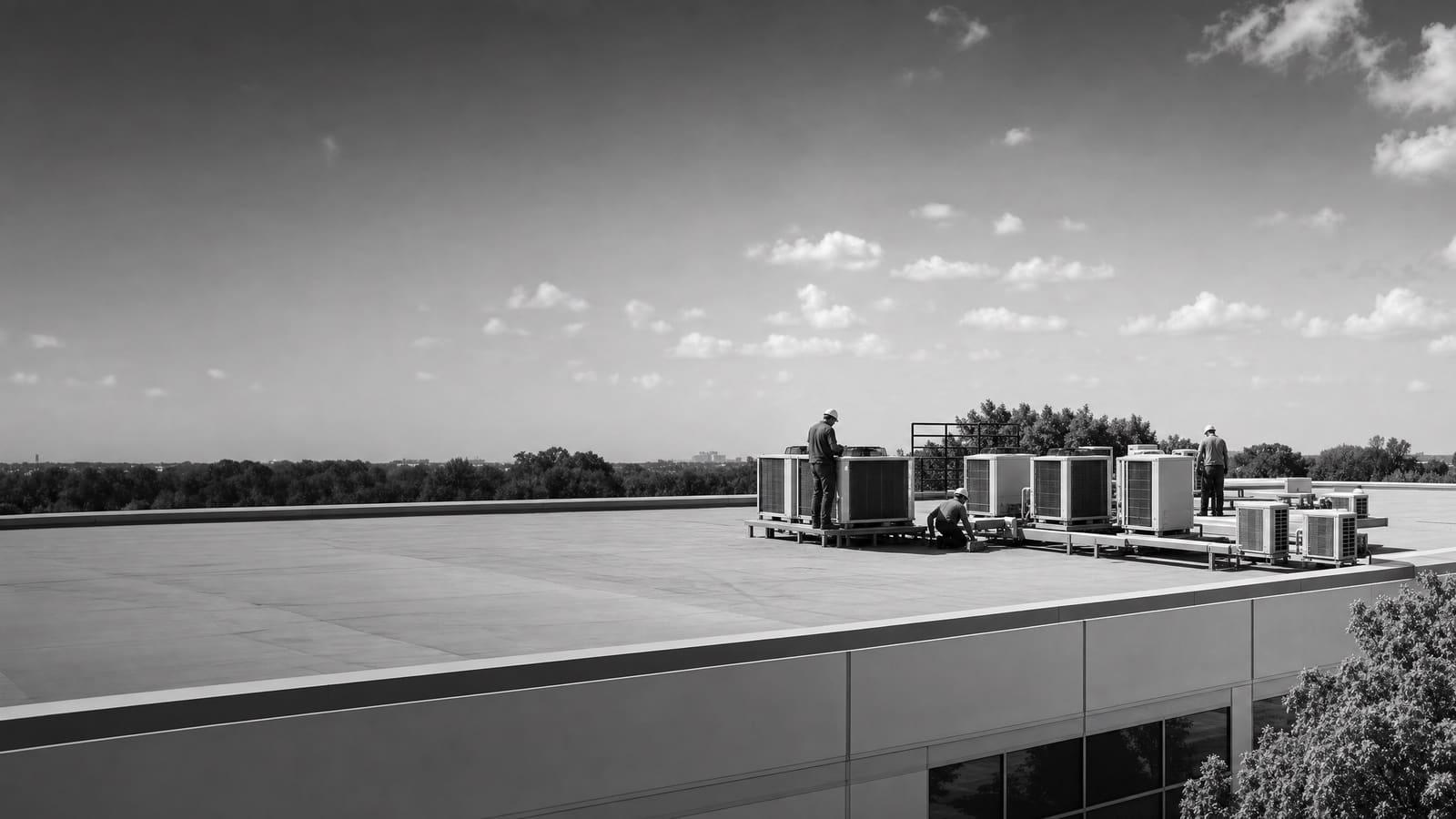
A commercial HVAC replacement covers confirming the load, selecting equipment, removing the old unit, setting and connecting the new one, and commissioning it so it performs to spec. Replacement beats another repair once the unit is old enough to lose money on its own. Federal analysis puts the waste from aging rooftop units at roughly $900 to $3,700 per unit each year, and flags units past 15 years as the ones worth acting on before they fail.
A site review still has to confirm tonnage against current use, curb and structural condition, crane access, and whether existing electrical and gas service supports the equipment you want.
THREE WAYS TO GO
Replace on failure, replace like-for-like, or plan the upgrade
Most buyers are choosing between three operating strategies, and the cheapest one on paper is rarely the cheapest across the unit's life.
Replacement on failure is the default. Run the unit until it stops, then buy whatever can be delivered. It costs nothing today and everything on the day it fails, because equipment choice collapses to whatever is in stock while the building sits uncomfortable.
Like-for-like replacement is planned but conservative. You buy the same size and type of unit, reuse the curb where you can, and get back to normal quickly. It also carries forward whatever the old unit got wrong.
A planned upgrade means deciding, before anything breaks, what the space actually needs. Federal guidance is direct about this: proactively replacing inefficient, underperforming units with more efficient ones is often the smarter business move compared with replacement on failure, or even with a like-for-like swap at the end of an old unit's service life. Advanced controls belong in the same comparison, since retrofitting controls sometimes pencils out better than new equipment.
WHAT MOVES THE NUMBER
The lines that decide what your replacement costs
No honest page can quote an installed price for a Montgomery roof it has not seen. What it can do is name the lines that move the number, so you can tell whether two quotes describe the same job or two different ones.
IN PRACTICE
Choosing the equipment before the crane is scheduled
The equipment decision has narrowed to a real fork. A conventional air-conditioning rooftop unit with gas heat is still the straightforward replacement for a building already plumbed for gas. A heat pump rooftop unit is technologically similar and adds reverse-cycle heating, which is why it now belongs on most replacement shortlists rather than being treated as a special order. Rooftop equipment of one kind or another cools nearly half of all commercial floor area in the country, so this fork covers most buildings.
Federal guidance is reasonably clear about where each fits. Heat pump rooftop units are most efficient with mild-to-moderate winter heating, and DOE treats today's units as an appropriate solution across most of the South and West, capable of handling most or all of the winter heating demand. Efficiency falls as outdoor temperature drops, trending toward parity with electric resistance heat, and southern buildings still see occasional sharp cold snaps. That is why dual-fuel and all-electric configurations both exist, and why the backup heat source is a specification rather than an afterthought.
What settles it for a specific roof is infrastructure. The federal checklist runs through electrical capacity, physical constraints, and existing gas lines before it gets anywhere near preference. If the panel cannot carry an all-electric unit without a service upgrade, that cost belongs in the comparison on day one. Electricity and gas prices decide whether the switch lowers the operating bill, so run that math on your rates, not a national average.
SCOPE CHECK
What makes a replacement simple, and what makes it complicated
Two jobs at the same tonnage can be a week apart in schedule and far apart in price. The difference is almost never the box. It is what the building asks you to change on the way in.
LOWER COMPLEXITY
Same size, same service, clear roof
The new unit matches the old one's capacity and fuel, the curb takes a standard adapter, and existing electrical and gas service is reused as-is. The crane has clean reach and the lot can give up stalls for a morning. Engineering is minimal, and the schedule is driven mostly by equipment availability.
HIGHER COMPLEXITY
New capacity, new fuel, or tight access
Tonnage or footprint changes, so structural review enters. Switching from gas heat to all-electric can require new electrical capacity. Add screened equipment, occupied tenant space below, restricted crane positioning, or building automation that must be re-integrated, and the project becomes a sequence rather than a swap.
BEFORE YOU BUY
What the site review has to settle
The most common way a commercial replacement goes wrong is sizing from the nameplate. A unit installed fifteen or twenty years ago was sized for the occupancy, plug load, lighting, and envelope of that building at that time. Almost none of those are the same now. Confirming the load against current use is what turns a replacement into a fix instead of a re-run of the same complaints.
The review should also settle the boring physical facts before equipment is ordered. Curb dimensions and condition. Roof structure at the unit location. Panel capacity and available breaker space. Whether gas service stays or goes. Crane reach from the only place a crane can actually sit, and how long that area can be closed.
Availability belongs in the same conversation. Federal adoption guidance names equipment availability and contractor familiarity as genuine constraints, not scheduling trivia. The efficient unit you want is worth nothing if it lands eleven weeks after your busiest season starts. A good scoping visit ends with two or three equipment options, each carrying an installed price and an honest lead time.
The one question that changes the quote
Ask what the load calculation is based on. If the answer is the old unit's nameplate, you are buying the last building's HVAC system. If it is current occupancy, equipment, and operating hours, the quote is describing the building you actually run today.
OWNERSHIP MATH
Two things the purchase decides for the next fifteen years
An installed price is a one-time number. Almost everything else the purchase decides shows up monthly, for as long as the unit sits on the roof.
Two of those consequences are worth deciding on purpose rather than discovering later: what the unit costs to run, and what it costs to service. Both are locked in the day the order is placed, and neither is easy to change afterward. If the building is leased, note which of the two lands on the owner and which lands on the tenant. A replacement decided purely on capital cost often moves money from one line to another rather than saving it.
OPERATING COST
The efficiency step you skip is permanent
Aging rooftop units waste roughly $900 to $3,700 per unit each year. The federal high-performance specification targeted units cutting energy use by up to half against the prior standard, and manufacturers responded with more than twenty models exceeding it. The gap between minimum and high efficiency is a purchase-day decision you pay for either way.
SERVICE AND PARTS
You are also buying a service posture
Refrigerant handling in stationary commercial air-conditioning and heat pump equipment is regulated under the Clean Air Act, so recovery and servicing remain certified work for the life of the unit. If you run a mixed fleet, reflect a newer unit's refrigerant in the service contract and the spare-parts plan.
PHASING AND PROCUREMENT
Replacing several units without replacing them all at once
Buildings rarely have one aging unit. They have five, installed the same year, aging on the same curve. Replacing all of them in a single season is clean but capital-heavy. Replacing them one failure at a time is how a portfolio ends up with five different makes, five service relationships, and no leverage with anyone.
The middle path is a ranked plan. Rank units by age, runtime, repair history, and the value of the space each one serves, then replace in that order on a schedule you set. The Advanced RTU Campaign is the large-scale version of exactly this approach: more than 200 public and private organizations upgraded over 43,000 rooftop units and cut a combined $37 million a year in energy spend by treating replacement as a program rather than an emergency.
Two things make phasing work. First, standardize where you can. The same manufacturer and control platform across the plan means one parts strategy and one integration effort instead of five. Second, check incentives before each phase rather than once at the start. Federal and utility program terms change, and a rebate you confirmed two years ago may not be the rebate available when phase three goes out for pricing. Confirm what applies at the time you order.
QUOTE CHECKLIST
Five things a comparable quote has to show
Two quotes are only comparable when both describe the same scope. These five lines are where quotes usually differ without appearing to.
01
The load basis
Whether the size came from a current load calculation or from the old unit's nameplate, stated plainly.
02
Equipment, tier, and lead time
Make, model, tonnage, fuel type, efficiency tier, and a delivery window you can plan a shutdown around.
03
Everything above and below the curb
Curb adapter, structural work, roofing, and any electrical, gas, or refrigerant line changes on the way in.
04
Rigging, permits, and inspections
Who owns the crane day, lot closure, permits, and inspection sign-off, priced inside the installed number.
05
Commissioning and warranty terms
Verified charge, airflow, and control settings documented at handoff, plus what the warranty requires you to maintain.
Keep planning locally
Related mechanical pages in Montgomery
Get a defensible number
Price the equipment and the building together.
Send the address, operating target, and target opening date. Flux will identify what must be verified before the project can be priced.
Get a free estimateQuestions
Straight answers.
When is replacing a commercial HVAC unit better than repairing it again?
Once the repairs stop being isolated events and the unit is old enough to lose money on its own. Federal analysis puts the annual waste from aging rooftop units at roughly $900 to $3,700 each, and treats units past 15 years as the candidates worth replacing proactively rather than waiting for failure.
Should a commercial replacement be a heat pump or a gas unit?
Heat pump rooftop units are technologically similar to air-conditioning units and add reverse-cycle heating. Federal guidance treats them as fully capable across most of the South and West. The deciding factors are electrical capacity, existing gas service, and your own utility rates — not the equipment category itself.
How long does a commercial HVAC installation take?
The visible on-site work for a straightforward packaged swap is brief compared with the wait for equipment. Schedule is usually set by lead time, not labor. That is why availability belongs on the quote next to the price, and why deciding before failure leaves you more choices.
Can better controls take the place of a full replacement?
Sometimes. Federal guidance gives owners both paths — replace the unit or retrofit advanced controls — depending on which makes better financial sense. On a unit with real service life left and no capacity problem, controls can be the better answer. On a twenty-year-old unit, they rarely are.
What happens to the refrigerant in the old unit?
It is recovered, not vented. EPA rules under the Clean Air Act govern refrigerant handling in stationary commercial refrigeration, air-conditioning, and heat pump equipment. Recovery and disposal are certified work and should appear as a scoped line in the quote rather than an assumption.
Sources used for this guide
- [1]betterbuildingssolutioncenter.energy.gov — DOE Advanced Rooftop Unit Replacement Guidance
- [2]betterbuildingssolutioncenter.energy.gov — DOE Commercial Heat Pump Rooftop Unit Replacement Guidance
- [3]betterbuildingssolutioncenter.energy.gov — DOE High-Efficiency Commercial Rooftop Unit Toolkit
- [4]energy.gov — DOE Efficient Commercial Rooftop Air Conditioner Program
- [5]epa.gov — EPA Stationary HVAC Refrigerant Management